
Computers, smartphones and other technologies are changing people’s lives every day. According to Robert W. Clowes’ article, the way people read had changed too. And if they changed, should we worry about it? I did an experiment in order to understand how my reading habits had transformed since I was a kid.
Robert W. Clowes
“Screen reading and the creation of new cognitive ecologies”
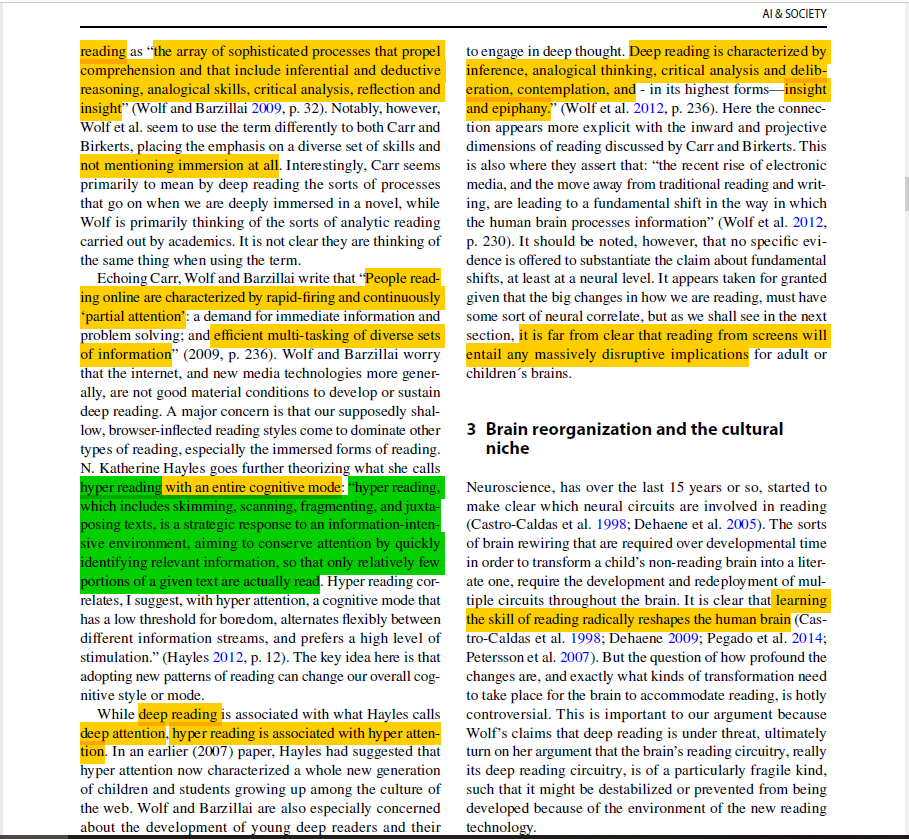
In his article “Screen reading and the creation of new cognitive ecologies”, Clowes describes hyper-reading as “a strategic response to an information-intensive enivronment” aimed to extract the information in a short time. While with hyper-reading you are constantly switching between various sources, deep reading involves concentration on a one source, even an immersion into it. The question is, did our ability for deep reading get worse with the emergence of hyper-reading?
When I was younger I read only paper books, but then the high school and university forced me to do lots of researces that involved the type of reading which I can consider a hyper-reading. Did technologies make my ability to read paper books worse? I spent 30 minutes looking for the information about Russian financial crises for my macroeconomics home assignment and then spent an hour reading a fiction book in order to find the answer.
Experiment details:
- Place: home, workplace in my personal room
- Texts: macroeconomics articles, Stanisław Lem’s “Return from the Stars”
- Hyper-reading tools: laptop, notebook, smartphone.
- Deep-reading tools: paper book.
- Hyper-reading tools were arranged in the way it’s possible both to read from the laptop and take notes.
Hyper-reading experience: with various macro articles my reading just had to be non-linear and my reading was frequently interrupted by highlighting the important information. I also used the page-searching tools to find the exact paragraph I wanted to read instead of reading the whole article from the beginning.
- I looked through 7 articles in 30 minutes
- I looked at my phone 3 times (6 phone looks / hour) (because the important information is highlighted anyway and so don’t risk missing it)
- I read each article for average of 2-3 minutes and then switch to another (sometimes I was returning to already read articles to compare the information)
Deep-reading experience: I sat with the book and read the novel linearly for an hour. I was distracted couple times but I don’t think that it was frequent enough to do a serious damage to an immersion process. So, I guess, my deep-reading skills can be considered well-preserved.
- I read the same one book for an hour
- I looked at my phone 2 times (2 phone looks / hour)
- I was concentrated for around 15-20 minutes between various distractions

I do think that hyper-reading is describing my process of reading for academic purposes, but I don’t think though that I would someday highlight the keywords in a novel or read couple novels simultaneously in order to extract the main point faster. In my opinion, hyper and deep reading don’t substitute but complement each other allowing you to adjust your reader’s experience for the various purposes.
It may be true that people now spend less time reading paper books. But it doesn’t necessary mean that we became worse at deep-reading. The technologies gave us the tools to extract the information more effectively but when you don’t rush for the information, you can still sit on your couch and enjoy good old linear reading.
 Another Part of the Digital World
Excellent post. I love how you show your highlighted text. It’s really interesting to see what you highlighted.
LikeLike