Why brands are friendly on Social Media and what should we do about it?

Now almost every brand (even if it’s your local store) has an account on Facebook and is always open to friendly chat with you in the comments. That is because, along with the growth of social media, the marketing potential of social media for brands is also growing. And that’s why you should understand the situation in order to not be tricked by brands acting like your friends. But no matter if you’re trying to avoid the traps or not you benefit from the brands’ persistence in social media.

Long-long time ago (in 2012), when the social media weren’t as pervasive as now, Turkish researchers (Erdogmus and Cicek) had surveyed 338 people in Turkey and discovered that marketing on social media can positively affect brand loyalty of customers (Erdogmus 4-5). The researchers said that “the study can be considered as a pioneer in this new area of marketing” (Erdogmus 1). In 2014 other researchers (Balakrishnan, Dahnil and Yi) surveyed 200 students in Malaysia and showed that social media marketing also has an impact on purchase intention (Bamini 4-5). But it was just the beginning. During past 7 years a lot have changed, and now all brands use Facebook, Instagram and other platforms to engage with their customers. They even have the special well-paid people (SMM) who deal with social media and develop the best marketing strategy for various platforms.

So, why do the brands use social media? The answer is obvious: to make money. Why are they being friendly and responsive? Because, according to Sprout Social statistics, these traits customers value the most in brands, along with promotions and interesting visuals (sproutsocial.com). The more loyal the customers the more money they would spend during the next Christmas. The statistics is impressive but what is more impressive is that this is exactly how you (or any other customer) look for your favorite brand.  Not being able to recognize personal preferences, companies use big data to analyze the behavior of an average customer.

To show you how this looks from the brand’s side, I’ll use the guide for brands that teaches how to behave in social media. Neil Patel, the professional in the field of marketing, tells that brands should include ‘social proofs’ (the counters of likes and shares) and make posts emotional (that looks for me like ‘behave like a real person’ advice). Another advice is ‘Make your audience feel special and start your relationship with influencers by giving’ (Patel, sections 1-2, 6). Ian Bogost, the contributed editor in the Atlantic, shares his story about the Comcast (telecommunication company) sending him 10 pizzas as a response to his Twitter joke. He claims that this behavior is highly manipulative because, after these small gifts, customers tend to feel obliged in some way and become loyal customers without any intention (Bogost 17). The question is if this brands’ behavior should be considered as manipulation and if it should, what should we do about it?

However, the internet is not the only place where the companies are trying to trick you. Music, smells, even smiling letters in the logo of the firm – all these small things should make you pick “the right” product (Short 4-6, 13, 20-22). The situation looks the same in the social media: companies are trying to exploit some of the behavioral shortcuts to the customer’s mind. We can’t forbid brands to be friendly on social media the same way we can’t forbid them to place smiling letters on their products. Does it mean that consumers had already lost the fight? My point is, no matter if you think that brands are manipulating the customers or not, you benefit from the persistence of brands in social media.

It’s important to note that there are positive effects besides brands’ social media marketing strategies. It seems to me that during past years the level of customers’ service had increased even in Russia, where we always had a problem with firms who thought that customers should be happy just because they let them to buy something. So, if the companies become more responsive, we should not only think that they’re trying to manipulate us but also note that now you can get the feedback on your problems faster. Market generates competition. If one firm became more friendly on social media and started to attract the customers, other firms on the market would suffer from it losing the customers and would also need to become more friendly. As a result, all firms on the market had improved their service but no one received the advantage and so your choice between the firms on the market remains unbiased. Of course, in the real world some companies may have an advantage because they made it faster than the other but, nevertheless, in the long run customers would benefit from this competition.

Just waiting for the benefit from the competition in the long run is not the only way for you to choose. Learning about the marketing strategies is important because if you know where and how the traps are set, you can identify the traps and choose rationally, and so you don’t need the long run to reap the benefits. As example, you can use all the taxi services in order to collect all the promotions they offer and always pick the lowest price. If you differ from the target of the marketing strategy (which is targeted on the average person that doesn’t care much about all these tricks), you can use it as your advantage.

Brands are trying to engage with customers not because they are friendly and sociable or want to have fun. They have the practical interest and lots of money involved in these interactions. But besides the manipulative sides of the brands’ behavior on social media, there are positive moments. And you can benefit even more if you understand the tricks they use. If company wants to have your money, it’s your right to ask it for the appropriate level of service. Don’t perceive brand-customer interaction as a war for your money, perceive it like a game in which you and brand decide who would benefit more.

Sources:

  1. İrem Eren Erdoğmuş, Mesut Çiçek, “The Impact of Social Media Marketing on Brand Loyalty”, Procedea – Social and Behavioral Sciences, Volume 58, pp. 1353-1360, https://www.sciencedirect.com/science/article/pii/S1877042812045818
  2. Bamini K.P.D. Balakrishnan, Mohd Irwan Dahnil, Wong Jiunn Yi, “The Impact of Social Media Marketing Medium toward Purchase Intention and Brand Loyalty among Generation Y”, Procedea – Social and Behavioral Sciences, Volume 148, pp. 177-185,  https://www.sciencedirect.com/science/article/pii/S1877042814039366
  3. Ian Bogost, “Why Brands Are Friendly on Social Media”, The Atlantic, Oct. 2018,  https://www.theatlantic.com/magazine/archive/2018/10/brands-on-social-media/568300/, Accessed 22.04.2019
  4. Kevin Short, “12 Ways Corporations Are Secretly Manipulating Your Emotions”, HuffingtonPost.com, 06.12.2017, https://www.huffpost.com/entry/corporate-marketing-strategies_n_5936942, Accessed 22.04.2019
  5. Neil Patel, “7 Powerful Psychology Hacks That’ll Increase Your Social Media Engagement”, NeilPatel.com, https://neilpatel.com/blog/7-powerful-psychology-hacks-thatll-increase-your-social-media-engagement/, Accessed 22.04.2019
  6. The Q2 2017 Sprout Social Index, SproutSocial.com, https://sproutsocial.com/insights/data/q2-2017/, Accessed 22.04.2019

Do video games make our ability to read worse?

Image by Gillian Blease/WIRED

It’s a popular view among parents that video games harm their children’s learning process by making them unable to concentrate for a long period. Does it mean that kids who play video games will have problems with reading skills, as example? In her book “Mind Change”, Susan Greenfield claims that gamers may have a problem with sustained (long-period) attention (Greenfield 161), but new researches and my own experience show that video games don’t have palpable negative effects on both short-term and long-term reading skills, and so the effect on a sustained attention needs to be examined more closely.

According to Greenfield, “sustained attention is an ability to maintain vigilance over longer periods of time and is often required during a tedious activity” (Greenfield 161). Douglas A. Gentile and his colleagues (Swing, Lim and Khoo) examined over 3 thousand children and adolescents in Singapore by asking them to assess their behavior with/without playing video games. As a result, they suggested bidirectional causality between playing video games and attention problems (Gentile 67), which means that video games do cause attention problems. One of the possible mechanisms that Greenfield suggests for an explanation of the negative impact is based on a brain’s ability to adapt. When you constantly stay in an action gaming environment, which requires you to react fast and switch fast to another target, your brain adapts and expects the same environment in the real life, decreasing your long-term concentration abilities in favor of short-term focus

Reading is perceived as an activity that requires concentration over a long period, so it should require mostly the sustained attention. So, taking into account Gentile’s research, you can suggest that video games may cause problems with children’s reading skills too. However, Sandro Franceschini and his colleagues (Trevisan, Ronconi et al.) had discovered that action video games improve reading abilities of children with dyslexia (Franceschini 1-2). For the experiment, they took 28 dyslexic children and found the significant difference between those kids who played AVG (action video games) and those who didn’t (Franceschini 3-6). In 3 months after Franceschini’s paper was published, Alexia Antzaka (together with Lallier, Meyer et al.) studied an impact of AVG not only on kids with dyslexia but on all people. Their experiment, which was done with 38 normal adults (without dyslexia), also showed the attentional benefits of playing AVGs to reading. Both experiments showed that playing AVG increases people’s reading speed without loss of reading accuracy (Antzaka 1).

So, how video games can improve reading skills? Researchers suggested that it is connected with enhanced visuo-spatial attention. As example, gamers can see more letters at a time, so they can spend less time converting letters into words. Also, they can read the next word faster because AVGs taught them how to better process two or more objects simultaneously. In her book, Greenfield mentioned visuo-spatial and visuo-motor skills improvement (Greenfield 157-158), but now we see that these selective (short-term) attention improvements can also have positive effects on sustained attention activities like reading. But these experiments mostly tested the abilities of people to read during a short period of time. Tasks included fast (less than 100 ms) letter recognition, sequence of letters recognition and pseudo-word recognition (Antzaka 7-8). But in real life reading is a bit different process. What if video games do have a negative impact not on the reading speed or reading accuracy, but on the time which people can spend reading without being bored or distracted by something?

Unfortunately, I don’t have 38 French right-handed adults to conduct a real scientific experiment, but I have my own experience that allowed me to conduct a small one. Until I was 11, I barely played video games but read books often. Then, in my middle school I was playing video games (including AVGs, such as Counter-Strike, Borderlands etc.) a lot. So, according to Susan Greenfield, my brain should’ve adapted from reading to fast-changing environments, and my ability to concentrate on a book could have become worse. To check this hypothesis, I made a small experiment. Firstly, I was looking over scientific articles using so-called “hyper-reading” for 30 minutes and then read a book for an hour, counting how many times I would get distracted. Using this experiment, I discovered that my deep-reading abilities didn’t significantly deteriorate (Neff 5).

The reading experience changes with the development of computer technologies and video games in particular, but changes are not always a bad thing. As example, one of the popular video game genres now is a visual novel. It’s a kind of a book, in which you have a choice of character’s actions and speeches. So, playing visual novel commits you to read a lot and for sure can’t have a negative effect on your reading skills. Even in “most hated” by researchers (because of the addictiveness) MMORPGs you need to read lots of things from your quest tasks to the loot descriptions. So, it would be incorrect to completely distinguish between video games and reading.

The idea that improvement in one area doesn’t have to be necessary compensated by a deterioration in other area was mentioned by Robert W. Clowes as a “Massive Redeployment Hypothesis” (Clowes 5). So, it can be true that video games have a positive impact on a selective attention without having a negative impact on sustained attention. Then, it won’t be unnatural if we decide that video games are beneficial for both children and adult’s reading abilities. But reading is only one of many activities that require sustained attention, so we shouldn’t completely throw away Greenfield’s claim. Some of the skills may get worse, some may get better, and it’s too early to take tech-pessimistic side as Greenfield does, but it’s important to analyze such claims in order to not miss something crucial.

Sources:

  1. Greenfield, Susan. Mind Change. Random House. 2015
  2. Gentile, D.A. “Video Game Playing, Attention Problems, and Impulsiveness: Evidence of Bidirectional Causality”. Psychology of Popular Media Culture 2012, Vol. 1, No. 1, 62–70. https://psycnet.apa.org/record/2012-04279-006
  3. Franceschini, Sandro et al. “Action video games improve reading abilities and visual-to-auditory attentional shifting in English-speaking children with dyslexia”. Natureresearch Journal. 19.07.2017. https://www.nature.com/articles/s41598-017-05826-8, Accessed 21.02.2019
  4. Antzaka, Alexia et al. “Enhancing reading performance through action video games: the role of visual attention span”. Natureresearch Journal. 06.11.2017. https://www.nature.com/articles/s41598-017-15119-9, Accessed 21.02.2019
  5. Neff, Artemiy. “Hyper-Deep Reading”, 08.02.2019. https://anotherdigitalmedia.home.blog/2019/02/08/hyper-deep-reading, Accessed 21.02.2019
  6. Clowes, R.W. “Screen reading and the creation of new cognitive ecologies”. AI & Soc (2018). https://doi.org/10.1007/s00146-017-0785-5 , Accessed 21.02.2019

Friend with a brand.

– f***ed onto [accidentally head-butted] satyr’s hoof in the Pushkin Museum
– [Pushkin Museum Official] Hope you were not injured

If I told you 5 years ago that in 2019 you would be spending time chatting with your local store in the comments on Facebook, you would think that I’m a bit out of my mind. But times had changed, and brands are now actively using Social Media to engage with their customers online. Despite some people argue that this strategy is manipulative, my opinion is that Social Media ushered a transition to the new world of better customer service.

What is the point for global brands to hire special people who will monitor Social Media in order to immediately answer your question or even just respond to your silly joke? Does this technique pay off? Well, it does. In my opinion, there are two key factors that drew brands to active using of Social Media.

  • As the SproutSocial report reveals, “Being Responsive” is #1 brand action that prompts consumers to purchase. It’s even more effective than offering lower prices (promotions).
  • Some of the personal cases may become viral and well-known, and so it’s very important for brands to avoid negative communication with every customer, while positive experience of one person may be translated to hundreds and thousands.
Being responsive = being successful

Social Media has a huge impact on a brand’s wellbeing no matter how big it is. As example, you may remember that after Elon Musk smoked weed on the radio show, Tesla stocks price decreased by 4%. Vice versa, after helping someone who’s in trouble, instead of getting one loyal customer you can accidentally get thousands.

Sounds too good to be true

But it would be naive to think that brands genuinely want you to be their friend. As Ian Bogost, a contributing editor at The Atlantic, argues, the small presents the companies make (Comcast [telecommunication company] sent him 10 pizzas in response to his Twitter joke) are highly manipulative. Thanks to Big Data, companies can discover everything about you and then say exactly what you want to listen. Then, if a company did something special for you, you would likely feel obligated and would also share your experience with your friends, which would give the company considerable advantage on the market.

But I think that in this case it is great that companies are trying to manipulate you. Along with the market always comes the competition. If some of the firms became responsive to their customers, other would need to be more friendly too. So, if you look at the overall picture, the level of service has to increase. Well, of course there are still also many places (especially in Russia) that don’t care much about their customers but, in my opinion, it is just a matter of time. Since you understand why the companies are becoming friendly, you can take advantage of the situation. In short, if every company sent you a pizza, you wouldn’t change your preferences but you would have a lifetime supply of pizzas.

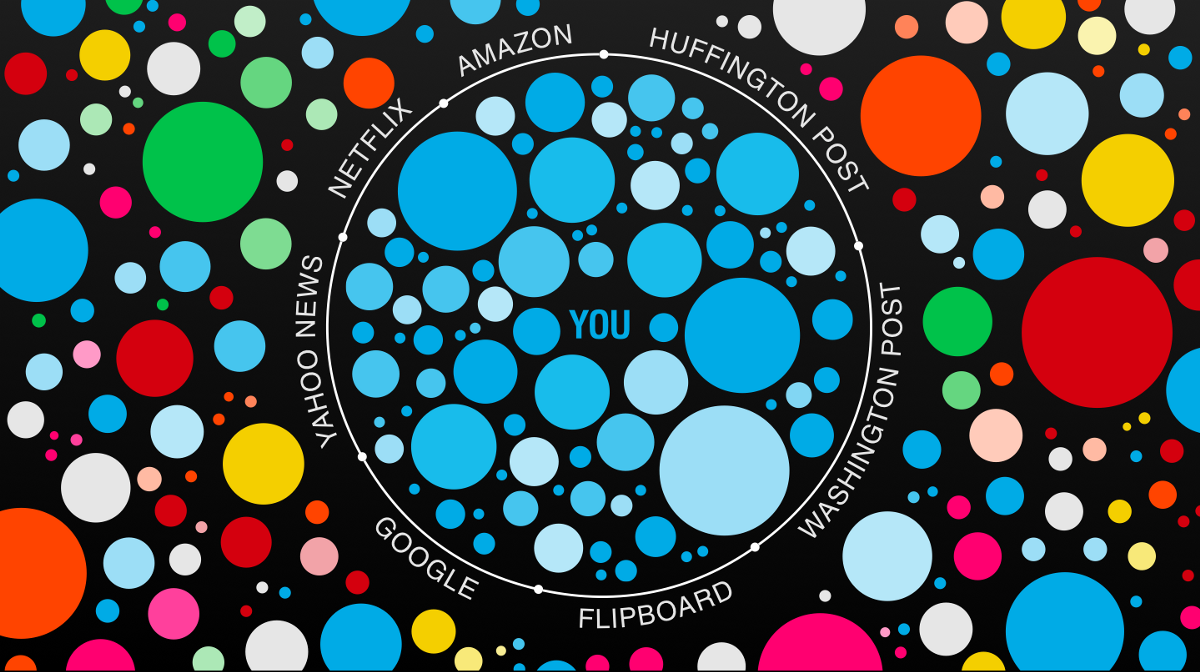
Should we be afraid of Filter Bubbles a(n)d Ech(o) Chambers?

Are you sure that your thoughts aren’t the thoughts of a computer algorithm?
[Picture taken from Medium.com]

In his TED Talk, Eli Pariser expressed the concern about “filter bubbles” in the internet that shape the way you think. However, scholars Dubois & Blank argued that the concerns about filter bubbles and “echo chambers” are overstated. In order to resolve the controversy I made an experiment which showed that I’m more on the Dubois’ side.

Let’s start with some terminology. The echo chamber is “a situaton where only certain ideas, information and beliefs are shared” (Dubois 1). Filter bubble is one of the echo chambers’ cases, based on the algorithmic issue. The search algorithm selects only the “relevant” news for you, filtering the news that contradict with your current opinion. This process makes people’s opinion more polarized and thus radicalized.

The Flat Earth Society as
an example of the radicalized opinions

Pariser and Dubois have different opinions about the search algorithms. Pariser shows the example where two people get different results on the “Egypt” request in Google, proving his point of filtering the information. In contrast, Dubois & Blake claim that the problem of echo chambers is overstated because people tend to search for the various perspectives in the different media sources.

In my small experiment, I tried to find out how easy it would be to find the information on the particular political issue and how it will differ for the different “alter egos” of me as an internet user. Let’s say that I live in Russia and I want to find out the information about Brexit that is a big political issue now (on the April 2019) in the UK.

Yandex Browser, “Artemiy the main user”

On the top we see two articles from the solid government media (РИА Новости) and one article from the more liberal media (РБК). We also get the Wikipedia on the right, so we can read the history of this issue. I consider this result sufficiently diverse to get the comprehensive picture of an issue.

But what if it is because of my previous searches that made algorithms work well only for me, but not for other people?

Yandex Browser, “Artemiy the Anonymous”

In the incognito mode we see the similar picture (except for one link for the Ukranian news site, which [in my opinion] doesn’t ruin our comprehensive picture.

What if Yandex Browser just pretends to make me “incognito” while still using the cache of my previous searches? I don’t use Microsoft Edge for the internet surfing, so it doesn’t have any cache of my activities?

Microsoft Edge, “Artemiy the Loyal Microsoft User”

The same picture as with my “main” personality. What if the cache can be found on the computer and so any browser on my computer just gives the same results?

For those who don’t understand Russian, first two news are similar with the previous searches, and we still see the Wikipedia page.

The last “What if” that I asked was “What if all my devices are linked, and so it still identifies me as my main personality?” So, I asked my friend Nikita to make the same search at the same time.

Google Chrome, “Nikita, the Hunter”

Familiar picture, isn’t it?

Of course, there are some of the hyphotesis left to test (different age, country and stongly different political views) and more platforms to discuss (Facebook, Youtube etc.), but my point on the news searching is already clear enough. The search that is even slightly more specific than just “Egypt” would make Google work the same as it would work for a different person. So, everyone gets the same links in the same order and so the issue has almost nothing to do with the algorithms (and so the filter bubbles) at this stage. The one who makes the final decision is always the user, and so, in my opinion, it would be more honest to plead our own guilty rather than blame Google for the modern world problems.

The Attention Fair

Tristan Harris, former Google’s Design Ethicist, claims that Internet resources and apps (Facebook, Instagram, Snapchat etc.) compete for your attention (which converts in the time you spend watching ads) abusing your subconscious part. In his blog and TED Talk Harris points out some of the hijacks these companies use. I’m going to reflect on my experience of dealing with two of these hijacks I noticed before I knew Harris.

1. Instant Interruptions instead of “Respectful Delivery”

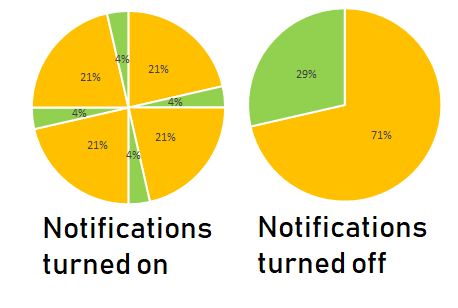
As I see my working experience with and without notifications.
Orange is working time, green – rest time.

Problem: No matter how much you love to chat with your best friends, it’s normal that sometimes you need to concentrate on other things. But then I occasionally see a nofication about the message in a Social Network. Should I answer right now or not? What if there is something important (although I am 99% sure it’s not)? But regardless of which answer I choose, I’ve already spent time on it and lost concentration. So, I spend more time on working and so I trade the comprehensive relaxation after working for the short disturbing breaks.

Example: VK mobile app doesn’t let you to turn off notifications for more than 24 hours, so you need to go to your phone settings to do so.

Solution: By turning out notifications (or just the internet on the phone which is only one-click to do), I bring all the time spent in Social Networks together making more pleasant and effective both my working and recreational periods. Although without notifications I have a temptation to check if there’re any new messages, it’s better to decide by yourself to quickly check it instead of waiting until it would interrupt my important thought.

2. Social Approval

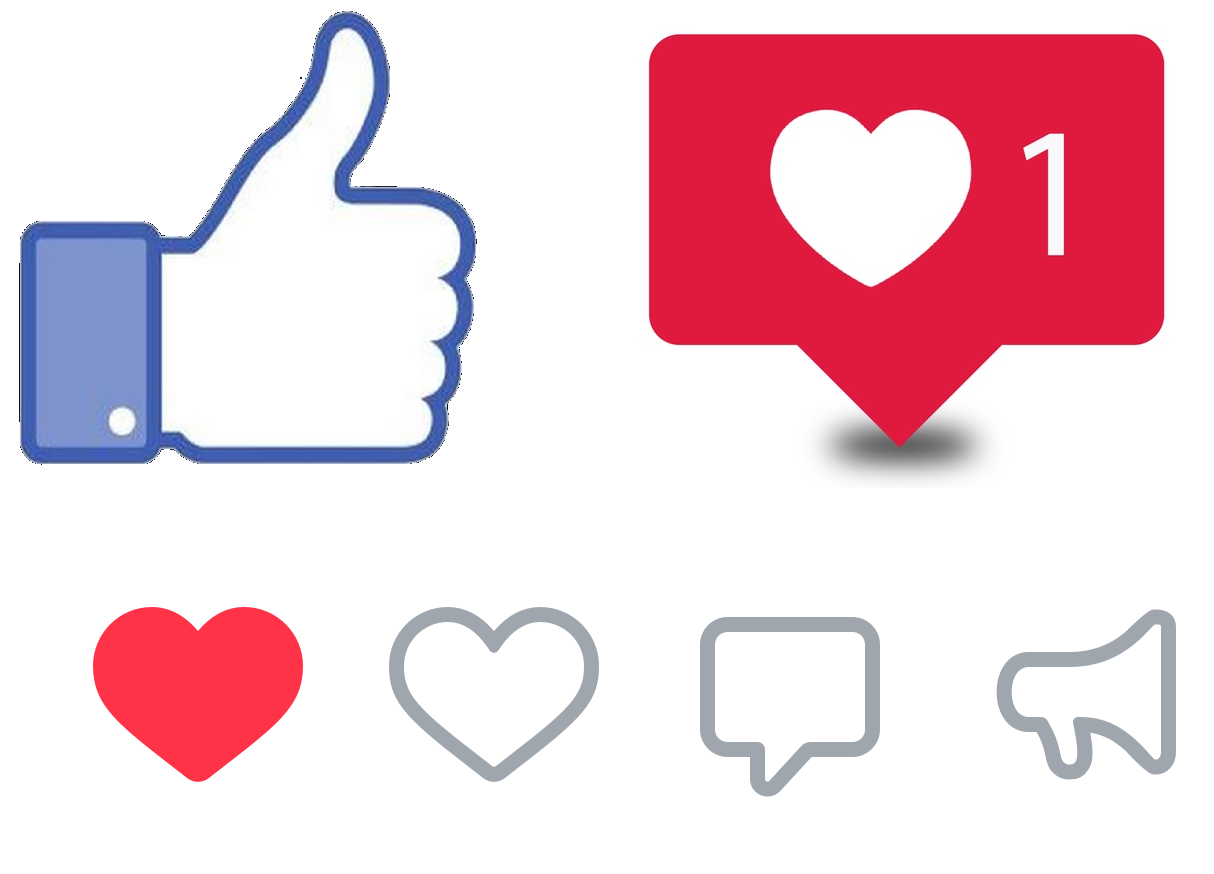
Does the number of “likes” show your successfullness?

Problem: Likes give people the quantative measure of Social Approval. Instead of your close friends’ opinion, you get a number of likes that you subconsciously compare with likes on your previous pictures and decide how “successfull” you are. So, when I upload a post or a story on Instagram (fortunately, I don’t do this very often), I’m can check Instagram maybe ten times more frequently then I usually do in order to see how many likes (or views in case of story) did my post get.

Solution: It’s too hard to stop perceiving likes as some “successfulness rate”, so my only solution is to post something only when you feel that you need to share it not only with your close friends but with everyone and that you will not care much about the amount of likes it would get.

I do think that some parts of my behavior are well-described by Harris but I don’t think that it’s the problem of tech companies. Irrationality is a huge part of human behavior and sellers always used it to make profits. The time we spent getting “caught” by Facebook or another company is just our price for it being free. So, I think that we should work on ourself to make our behavior more rational rather than wondering what would be if corporations would care only about people’s wellbeing.

Hyper-Deep Reading

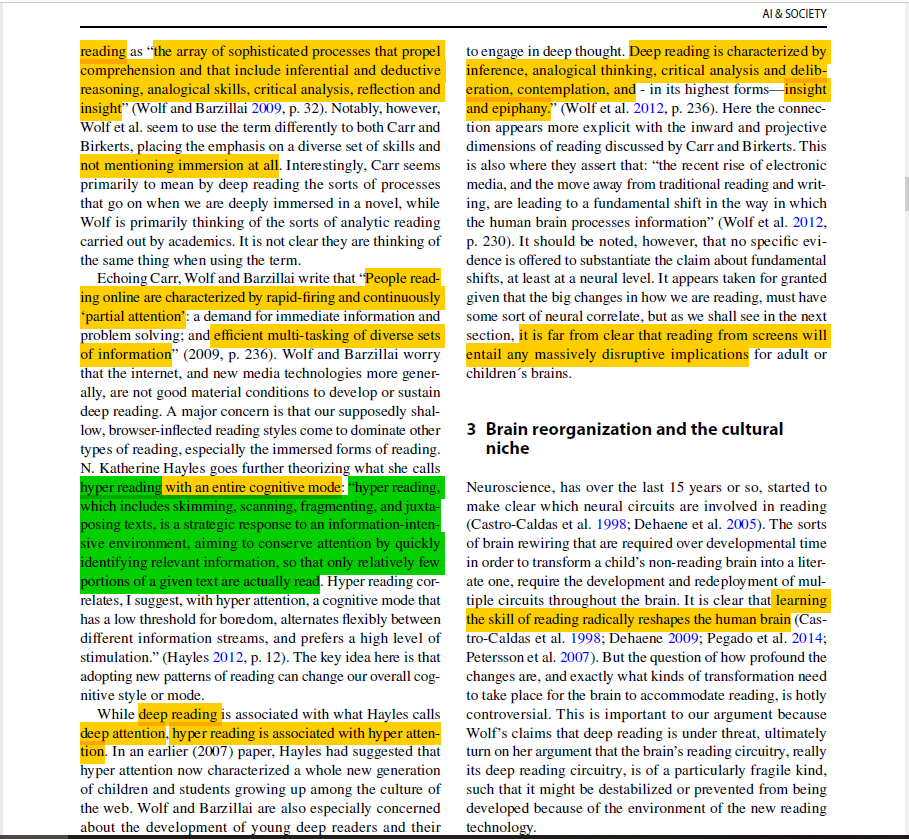
Computers, smartphones and other technologies are changing people’s lives every day. According to Robert W. Clowes’ article, the way people read had changed too. And if they changed, should we worry about it? I did an experiment in order to understand how my reading habits had transformed since I was a kid.

Hyper-reading the article about hyper-reading.
Robert W. Clowes
“Screen reading and the creation of new cognitive ecologies”

In his article “Screen reading and the creation of new cognitive ecologies”, Clowes describes hyper-reading as “a strategic response to an information-intensive enivronment” aimed to extract the information in a short time. While with hyper-reading you are constantly switching between various sources, deep reading involves concentration on a one source, even an immersion into it. The question is, did our ability for deep reading get worse with the emergence of hyper-reading?

When I was younger I read only paper books, but then the high school and university forced me to do lots of researces that involved the type of reading which I can consider a hyper-reading. Did technologies make my ability to read paper books worse? I spent 30 minutes looking for the information about Russian financial crises for my macroeconomics home assignment and then spent an hour reading a fiction book in order to find the answer.

Experiment details:

  • Place: home, workplace in my personal room
  • Texts: macroeconomics articles, Stanisław Lem’s “Return from the Stars”
  • Hyper-reading tools: laptop, notebook, smartphone.
  • Deep-reading tools: paper book.
  • Hyper-reading tools were arranged in the way it’s possible both to read from the laptop and take notes.

Hyper-reading experience: with various macro articles my reading just had to be non-linear and my reading was frequently interrupted by highlighting the important information. I also used the page-searching tools to find the exact paragraph I wanted to read instead of reading the whole article from the beginning.

  • I looked through 7 articles in 30 minutes
  • I looked at my phone 3 times (6 phone looks / hour) (because the important information is highlighted anyway and so don’t risk missing it)
  • I read each article for average of 2-3 minutes and then switch to another (sometimes I was returning to already read articles to compare the information)

Deep-reading experience: I sat with the book and read the novel linearly for an hour. I was distracted couple times but I don’t think that it was frequent enough to do a serious damage to an immersion process. So, I guess, my deep-reading skills can be considered well-preserved.

  • I read the same one book for an hour
  • I looked at my phone 2 times (2 phone looks / hour)
  • I was concentrated for around 15-20 minutes between various distractions
The photo is taken from here

I do think that hyper-reading is describing my process of reading for academic purposes, but I don’t think though that I would someday highlight the keywords in a novel or read couple novels simultaneously in order to extract the main point faster. In my opinion, hyper and deep reading don’t substitute but complement each other allowing you to adjust your reader’s experience for the various purposes.

It may be true that people now spend less time reading paper books. But it doesn’t necessary mean that we became worse at deep-reading. The technologies gave us the tools to extract the information more effectively but when you don’t rush for the information, you can still sit on your couch and enjoy good old linear reading.

Survivor of a Digital Childhood.

Lots of parents prefer to blame computers and other gadgets rather then themselves when it comes to the troubles of their kids. With the exponential development of technologies, the question of the impact that the digital world has on kids becomes more and more important. I’d like to discuss this question today with Susan Greenfield on the tech-pessimistic side and me (the person who grew up in 2000s) as her opponent.

Don’t hope to get the unambiguous answer.

In her book “Mind Change”, Susan Greenfield claims that kids now prefer to stay at home with gadgets rather than go outside and play with their friends or make new. Even the paradigm of playing had changed. While previously kids used toys and imagination to create their own story, now they prefer to receive the story from a creator of a movie or game. Even the most creative computer games can offer you only a range of activities that were set out earlier, while your imagination can go far beyond it.

Let me tell you some information about my childhood. I was born in 1999 in Moscow (Russia) and before the school my life wasn’t connected much with the technologies. We had a computer but it was more interesting for me to read books. However, I think that the fun part of reading in that age was not the creating of stories and developing imagination (as Greenfield suggests) but passing one page after another, from one book to another. Notwithstanding my love for reading I spent a huge amount of time on the streets playing football and doing other “normal kids” activities (I was active enough to fall from the two-storey playground face-down and break the hand when I was 7).

I played the “recepient” role a lot too. When I was in elementary school (2006-2010), I started to spend more time in front of the TV/DVD-player watching the movies and series on the channels like FoxKids and Jetix. Later in the middle and high school (2010-2017) I played online computer games a lot. Truly a lot. So, according to Greenfield’s book, I can consider myself a victim of a digital childhood. But I don’t.

Some key moments of my “digital childhood”:

  • Introduction to the Internet: 6 years old (2006).
  • First mobile phone: 6 years old.
  • Social Networks (Vkontakte): 8 years old.
  • First smartphone: 11 years old .
  • Introduction to computer games: 11 years old.
  • My first personal computer (that gave me the possibility to play almost as much as I wanted): 12 years old.

One of the main Greenfield’s claims is that computers are harmless only in case of “sensible” usage. But the fact that at some periods of my life I crossed this line of “sensibility” doesn’t really make me an addicted person with a wrong childhood.

The Internet helps you to complement (not substitute) the communication in real life. I went to school to see my friends and then we met together in the game speaking about our lives. Adults have these meetings too, but they prefer to use the smoke breaks or bars (which I don’t think is appropriate for kids). So, does it really matter where we chose to met? About 75 percent of the time I spent playing computer games I spent with my friends in Skype or other programs. There were many cases when I played with someone I see every day but don’t usually talk, and after some hours spent together we started to hang out and become good friends in the real life too.

Also, the Internet doesn’t force you to be only a recepient, allowing you to satisfy both your creator and recipient’s side. During my internet life I created a meme-page in Vkontakte and the YouTube channel, but also read a hundreds of interesting stories (that I visualized somehow using my imagination) and had seen thousands of memes.

“Meme” – a picture that contains some text on it together forming the joke.

As with the real world, the Internet gives you various opportunities and only you decide which one would you choose. And if after all you think that your choice was correct and you feel happy, then you had found your personal balance between the real and virtual life.

To be clear, I think that childhood with gadgets is not better or worse than “normal childhood” that kids like Susan Greenfield had before. It’s just different and depends on the parent’s sensibility and attention in exactly the same way as it did before. You can’t blame your kid for sitting in front of the computer instead of doing sports if you didn’t find together the sport your kid would enjoy.

The Little Box of Dogville.

In his article “Little Boxes, Glocalization, and Networked Individualism” Barry Wellman describes the paradigm shift in connection between people and institutions. We went from closed “Little Boxes” communities of small old towns to a world of glocalization and then, with the Internet development, to the so-called “Networked Individualism”. Lars von Trier’s “Dogville” gives us the rare opportunity to see an absolute “Little Box” community under the microscope to feel how life had changed in a century.

From “Little Boxes, Glocalization, and Networked Individualism”, Barry Wellman

In the era of “Little Boxes” people lived in small closed communities where everyone knows everyone, and your best friends are your neighbors. With the emergence of railroads and telephones the people from different “boxes” started to contact with each other more and more actively, but they were still pretty tied to concrete places (e.g. home, workplace) forming both global and local (“glocal”) connections. Now, when you can access a person in seconds through the Internet, the local connections had been left aside.

The map of Dogville

Dogville is a very small town with about 20 people living in it. It is located far from the civilization and the only way to see other people is to take a car and have a long ride. So, everyone knows everyone, and the only people one can spend time with are his/her neighbors. All the communications are made personally by coming into one’s house (door-to-door). And, as in any small town, there is absolutely no privacy in this village. The episode that illustrates well the Dogville people is the beginning of the Chapter 5. I invite you to watch the episode from 1:08:25 to 1:12:31.

Dogville, Chapter 5

We see all the villagers getting together at the dinner table to celebrate the Fourth of July. People enjoy the conversation even though they meet each other every day. When the police officer arrives, they discuss together what to do with the emerged problem. There just can’t be any secrets in Dogville because the neighbors will know about everything that happened with anyone from the town. And this closeness determines the life there.

Although the people in Dogville have wired phones, they don’t use them very often, because in order to call someone you need to meet someone new which is impossible in this town. So, they use the technologies of the surrounding glocalized world of the 20th century only in case of emergencies (to call the police as example).

In other aspects Dogville perfectly fits the Wellman’s concept of the “Little Box” community, and the viewer has almost three hours to explore the nuances of these communities. After the happy beginning, all the evil starts to come to a surface, showing you this “box” from all perspectives.

Don’t get confused with how the film was shot, this is von Trier

I bet that this film doesn’t describe your relationships with neighbors very well. And it is completely normal! The differences between the modern world and the world of Dogville make the film so interesting to watch. Today we barely know our neighbors because we have the opportunity to choose friends and colleagues literally from any place of the world. The communication had turned from door-to-door to person-to-person. The privacy of one’s life came to a new level too. You can easily have a good friend from the other country who plays the online-game with you and doesn’t know much about your real life.

It will take a long time to list all the differences, so I encourage you to make the comparison by yourself by watching the film. Often thinking about different people and different times can help you discover something new and important in your own life, so don’t miss the chance.